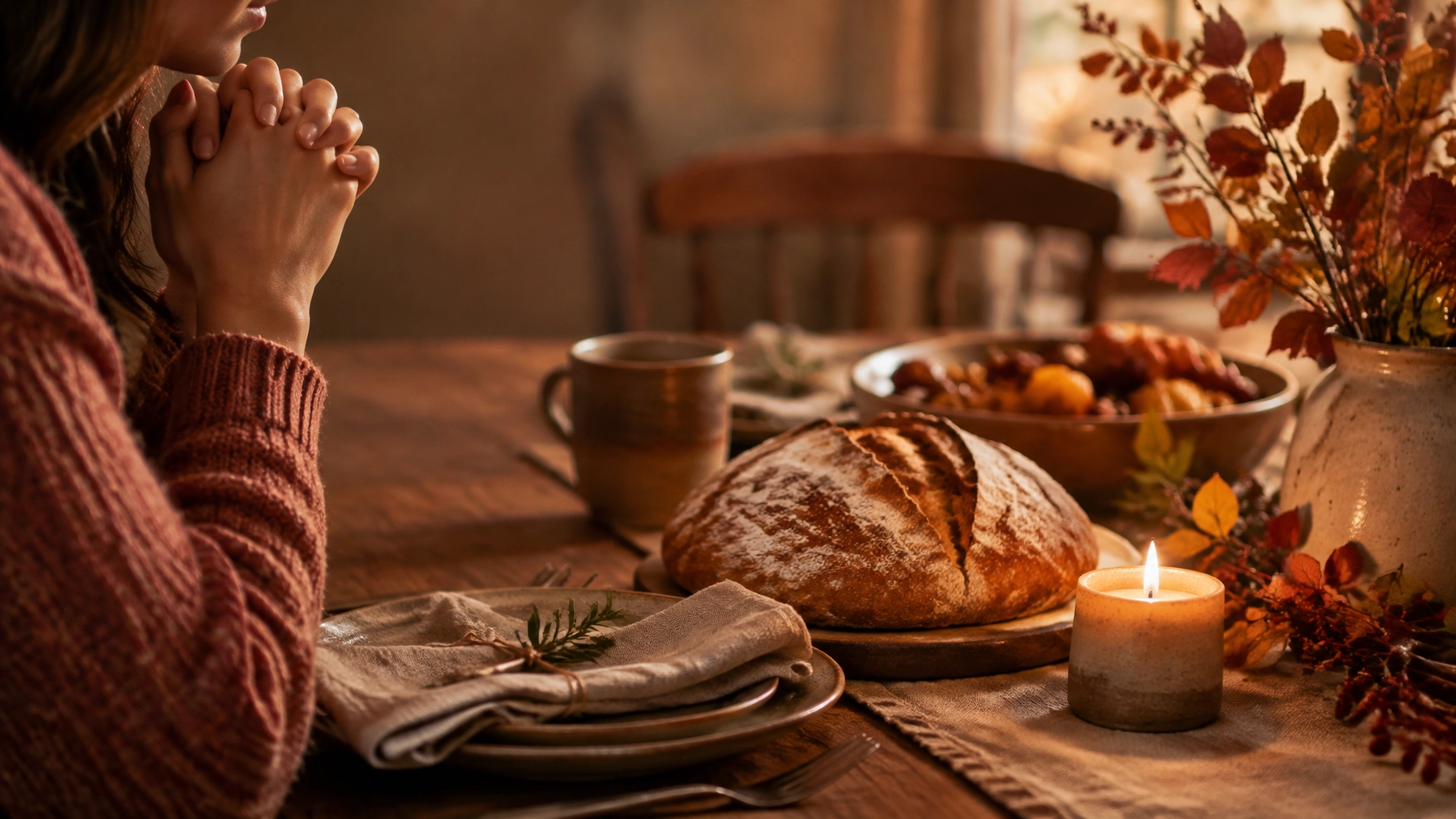
“Bless the LORD, O my soul, and forget not all his benefits.”- Psalm 103:2
What if the holiday arrives while your heart is still carrying loss? What if the empty chair, the unanswered prayer, or the difficult year makes gratitude feel like a language you have forgotten? And before the lists begin (groceries, errands, expectations) could you pause long enough to notice what God has already carried you through?
Thanksgiving can be a tender word. For some, it calls up full tables and familiar laughter. For others, it lands beside grief, exhaustion, or a season that did not turn out as hoped. The Bible does not ask us to pretend those sorrows are small. It invites us to bring our whole selves, our gratitude and our ache, before God.
So before you plan the meal or measure the day by what is missing, take a breath. Not to force a bright feeling, but to remember. Gratitude is not a glossy ribbon tied around pain. It is a small lamp we carry through it.
Gratitude is honest remembrance, not forced cheer
Psalm 103 begins with the psalmist speaking to his own soul: “Bless the LORD, O my soul.” Then comes the reminder: do not forget. The psalm goes on to name God’s mercy, forgiveness, steadfast love, and care (Psalm 103:2–5).
That pattern matters. The psalmist is not saying that every circumstance is easy or that suffering should be called good. He is calling the heart to remember who God is and what God has done, even when the present moment is complicated.
We can be thankful in a painful season without being thankful for the pain itself. Scripture’s call to “give thanks in all circumstances” (1 Thessalonians 5:18) is not a command to deny what hurts. It is an invitation to keep turning toward God within whatever we are facing. In the verses around it, Paul also calls believers to rejoice and pray continually (1 Thessalonians 5:16–18): not to perform happiness, but to keep bringing life honestly to the Lord.
Lament belongs in that life, too. The Psalms make room for questions, tears, and fear. To tell God, “This hurts,” is not to abandon faith. It is to bring the hurt into the presence of the One who hears.

What does “give thanks” mean?
The Greek verb often translated “give thanks” in 1 Thessalonians 5:18 is eucharisteō. It means to give thanks or express gratitude. The word itself does not mean that every painful event is a gift; the verse calls us to thanksgiving in every circumstance, not to pretend that every circumstance is good. You can explore the word’s definition in Bill Mounce’s Greek dictionary.
That distinction offers us a steadier path. Gratitude does not require you to call betrayal kindness, loss a blessing, or unanswered questions an easy lesson. It asks you to notice God’s presence and goodness without making grief disappear.
There is an either/or choice before us, not between sorrow and joy, but between remembering and forgetting. We can let today’s pain tell the whole story, or we can tell the truth about the pain while remembering the mercies that have met us along the way. The second way does not erase the wound. It gives the wound a wider story.
Pause before the lists begin
Holiday preparation can fill every margin: food to buy, people to contact, rooms to tidy, expectations to manage. Before the activity gathers speed, make a little space for remembrance. You do not need an elaborate ritual. A few honest minutes can be enough.
Try this simple practice:
- Name what is hard. Write down what you are carrying without editing it into something more acceptable. God is not surprised by your grief.
- Remember one mercy. It might be a friend who stayed, strength to make it through a difficult day, a meal, a safe place to rest, or help you did not expect.
- Give thanks specifically. Instead of “I’m grateful for everything,” try, “Thank You for the person who called,” or “Thank You for giving me enough strength for today.”
- Ask for help with what comes next. Gratitude does not mean you have to carry the holiday alone. Pray, set a boundary, or ask someone you trust to share the work.
This is not a test of how spiritual you are. Some days, the most truthful prayer may be: “Lord, I am hurting. Help me remember that I am not alone.” On another day, perhaps you can name three mercies. Both prayers can be sincere.

When thankfulness feels difficult
If gratitude feels out of reach this year, begin smaller than you think you should. You do not owe anyone a performance of joy. You may be grieving someone who will not sit at the table, facing uncertainty about work or health, or living with a relationship that remains strained. These are real burdens, not proof that you have failed at faith.
The enemy would gladly turn pain into isolation, whispering that your struggle means God has forgotten you or that you have nothing left to offer. Do not let that whisper have the final word. Speak honestly with God and, when you can, with a trusted person in your community. Sometimes the next faithful step is not a feast or a grand declaration; it is asking for help, resting, or letting someone sit beside you.
A prayer we might whisper is simple:
Father, I do not know how to make this season easy. You see what I miss and what I fear. Help me remember Your mercy without pretending I am not hurting. Show me one gift for today, and give me grace for the next step. Amen.
That prayer does not resolve every question. It opens a door for God to meet us in the question.
Let gratitude deepen your walk with Christ
Thanksgiving can become more than a holiday mood. Practiced through ordinary days, remembrance helps form a faith that is rooted in God’s character rather than the weather of our circumstances. This kind of growing in faith does not demand that you feel strong every morning. It invites you to return: to prayer, to Scripture, and to the quiet evidence of grace.
If you want to build a simple rhythm for that return, explore these steps for a consistent Christian walk and deeper Bible study. You can also find written teachings and other spiritual resources to support your Christian walk with Christ. Thoughtful online devotionals and Scripture-centered study can help us keep paying attention, not to manufacture gratitude, but to recognize God’s faithfulness as we grow.
And when the holiday itself comes, let it be honest. There may be laughter and tears in the same room. You may give thanks for the meal and still miss someone. You may celebrate a mercy while waiting for an answer. These things can stand together. Gratitude does not have to be loud to be real; sometimes it is a quiet “Thank You” spoken through tears.

Before the lists grow long, pause. Remember one mercy. Tell God the truth about your grief. Let someone help. Choose thankfulness, not as a mask, but as a way to keep your heart turned toward the One who has carried you this far.
PAUSE before the rush begins. REMEMBER one specific kindness. PRAY honestly, even if all you have is a question. RECEIVE help without shame. GIVE THANKS for today’s mercy, however small. WALK ON with God, one faithful step at a time.